Hedging Individual AI Job Loss
Published:
It's a bizarre time to be a Computer Science student right now. Discussing programming at all is now practically a strange archaism. People have resigned themselves to prompting Claude[^im-not-programming], using their current knowledge, basically whenever they can get away with it. Right now there does tend to still need to be a human to correct LLMs when they go wrong, but there's a general sense that the best days of working in tech are already behind us. Somehow, people haven't fully internalized this--planning as if a long career in tech is still highly likely. Taking a "total portfolio" perspective, I'd argue that given a long career in the tech industry tends to result in a lot of lifetime income (although it's not clear why), and AI threatens this and other similar knowledge work jobs, early-career programmers should be hedging against their future selves being automated away in how they invest their savings.
Why Haven't We Already Been Cooked?
Despite this looming vibe, AI doesn't seem to be showing up in the productivity and employment numbers yet. A CEPR column, whose authors include many economists at Federal Reserve Banks, runs through the numbers: in 2025 the measured impact of AI on productivity growth was only 0.6% and it's expected to increase to around 1.8% in 2026. Yet similar to how in 2025 METR found programmers overestimated the impact of AI on their productivity, "firms consistently report larger productivity gains from AI than those implied by contemporaneous changes in revenue and employment":
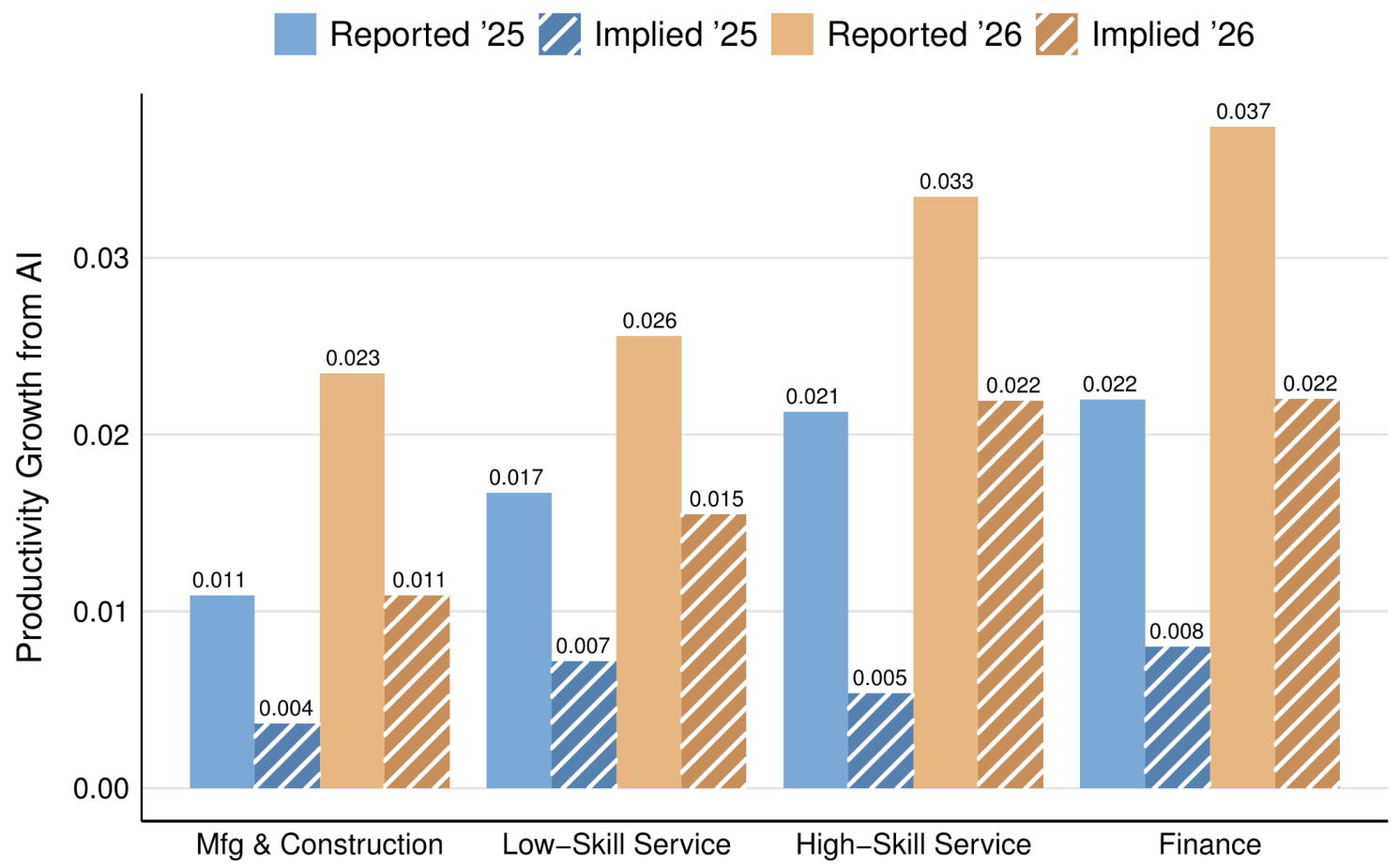
Adam Posen, president of the Peterson Institute for International Economics, gives two reasons for why this might be. The first, echoed by the CEPR column, is that it will simply take firms time to adapt to make use of AI productively. Both cite Brynjolfsson et al.'s work on the "J-curve", which argues AI is yet another example of what they call "general purpose technologies" (GPTs). GPTs, like "the Corliss steam engine", "computer hardware", and "software", produce an initial underestimate of productivity as firms invest into intangibles necessary to make effective use of the technology and then an overestimate of productivity as the result of these investments suddenly becomes visible in measurable outputs, producing a J shape in the measured productivity. Posen predicts this initial period will be "probably close to five" years.
The second is the Messy Jobs theory, which holds that while jobs have many parts that are amenable to automation, they also have less-obvious "messy" aspects including "the irreducible tangle of judgment, context, relationships, and improvisation that constitutes most real work" which the authors believe "cannot be accelerated by computation alone". In either case, I concur with Posen that "the job stuff" is "probably coming". Messiness is probably not enough to preserve the same level of tech employment, and if time is needed for firms to adapt to AI, that time will eventually pass.
Who Wins AI Profit?
Supposing AI automates a large number of programmers out of a job, it is not immediately obvious who will profit off of this. One thesis is that companies involved in the production of AI models will be unable to capture the value they create. Competition between model providers could cause pricing to be near costs. Like with shipping containers, the market as a whole would go up, but there wouldn't be any obvious individual winners. I find this unlikely unless progress stalls out relatively soon. Martin Shkreli[^shkreli-fame] gives the example of planning the next McDonald's menu item: if an LLM is better than competing LLMs at identifying which sandwich will have better sales numbers, it would be worth paying a very large premium for. If smarter models allow better results, better results will probably be worth paying for. This isn't even that theoretical: there are already people spending over a million dollars a month in profitable AI usage.
Will AI companies be able to keep these profits without them being gobbled up by their suppliers? In May, SemiAnalysis said the answer had been yes, and NVIDIA and TSMC have been undercharging for hardware relative to their pricing power. NVIDIA now faces stronger competition from AMD and TPUs, and as Anthropic noted in their IPO roadshow, advances in AI make spinning up usage of non-CUDA chips easier. There's not much I'm aware of stopping TSMC themselves from jacking up prices, but they probably can't increase them enough to capture all of the AI value.
Dario is alleged to have said that Anthropic will be the only company in the world. Given the previous discussion, it's hard to imagine frontier AI companies not becoming at least significantly larger provided they don't blow up (as Dario pointed out they might if they wind up overestimating compute demand). One frontier AI company blowing up increases the pricing power of the remaining frontier AI companies. With inference margins being rather large (85% for Anthropic), frontier AI companies are currently only unprofitable because they are racing to ship newer and better models.
Buying, Hyperstition, and Fast Takeoff
Given all of this, it makes sense for those at short-term risk of being automated away to have increased holdings in frontier AI companies. At the limit, if all work gets automated, the legal superstructure that gives shares value will probably not persist. Financial instruments are only as good a hedge as the system that enables them. There's also the consideration that by buying frontier AI companies, you are enabling them to do the automating away (and the extended consideration that this further enables "everybody dies"). I highly doubt the dollars swayed by these arguments here will cause any significant price moves, and I'm also skeptical that automating jobs away will be harmful on-net. Overall, I think early-career programmers, and those in similar positions, should consider weighting frontier AI stocks beyond market neutral.
Appendix: Stonks
There are three companies I'd consider plausibly "frontier" at the moment: Google, Anthropic, and OpenAI. Google has been publicly traded for a very long time, and Anthropic recently IPO'd. OpenAI remains a private company and doesn't plan to go public until next year. SoftBank shares are a potential way to gain exposure, but it also has large ARM shares, a bunch of debt, and leadership that wanted to do a trillion-dollar leveraged buyout of SK Hynix amidst this. If Meta locks in they could potentially be in the running, but for now it seems they'll keep doing non-frontier consumer stuff. Microsoft also seems to be trying to enter the race, but they have their work cut out for them as well. DeepSeek and Moonshot appear to be private. Z.ai is public, so there's that I guess.